
Crossword Puzzles
There's something satisfying about filling in that last stubborn word and watching a crossword grid finally come together. Play free crossword puzzles online, work through clues at your own pace, and enjoy the small victories along the way. Start with the answers you know, let the crossing letters guide you through the tricky ones, and come back for another daily puzzle whenever you're ready.
How to Play Crossword Puzzles
A few simple habits can make even a difficult-looking grid feel manageable.
Start with an across or down clue that looks familiar rather than tackling the hardest one first.
Enter the word into the numbered squares and check that it fits the available spaces.
Let the answers you've already found provide hints for the words that cross them.
Return to the difficult clues, correct any mistakes and work toward filling every square.
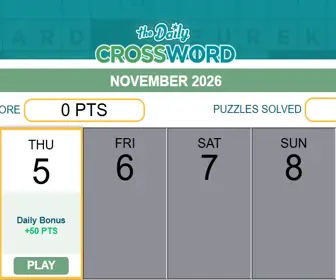
Free Crossword Puzzles Online: One Clue at a Time
Every crossword begins the same way: a grid full of empty squares and a list of clues that seem to range from ridiculously easy to completely impossible. You scan the first few questions, recognize a familiar answer, and suddenly there are letters on the board. That's usually all it takes to get started.
Crossword Puzzles brings that familiar experience to your browser. Instead of reaching for a newspaper and a pencil, you can select a clue, type your answer and move around the grid as ideas come to you. The daily format gives you a reason to return, but there's no need to rush through the puzzle just to finish it.
Some clues are straightforward definitions. Others rely on synonyms, general knowledge, or a slightly unexpected interpretation of an ordinary word. The interesting part is that you rarely solve everything in order. One answer leads to another, and a word you couldn't remember five minutes ago suddenly becomes obvious when two or three crossing letters appear.
How to Solve a Crossword Puzzle Online
If you're new to crosswords, don't worry about solving the entire grid in one pass. Most players jump between clues, gradually building a network of answers. Here's a practical way to approach your first puzzle:
- Scan the Clues First – Read through a few across and down clues without trying to solve every one. Look for definitions, names or everyday expressions you recognize immediately.
- Fill in Your Confident Answers – Start with words you're fairly sure about. These give you useful letters for other answers and help establish a foothold in the grid.
- Check the Word Length – Count the available squares before entering a guess. An answer might make sense as a definition but still be the wrong length.
- Switch Directions – When an across clue becomes difficult, try the down clues that intersect it. Even one new letter can change how you see the answer.
- Revisit Your Guesses – If several crossing words don't fit, one of your earlier answers may be incorrect. Don't be afraid to change it.
- Finish the Remaining Corners – Once most of the grid is filled, concentrate on the smaller sections that still contain unanswered clues.
One useful habit is to avoid getting attached to your first guess. Crossword clues can be deliberately ambiguous, and the most obvious answer isn't always the one the puzzle is looking for.
Across and Down: Why the Crossings Matter
The clever part of a crossword is that every answer is connected to other answers. An across word shares letters with several down words, and those intersections give you a way to check your guesses.
Imagine a clue asks for a four-letter word meaning "a small boat." You might think of canoe, but it doesn't fit. Maybe the answer is raft. If a crossing word gives you an R as the first letter, that possibility becomes much stronger.
This is why skipping a difficult clue isn't giving up. You're simply collecting information somewhere else on the board. Often, the best way to solve one clue is to stop looking at it for a moment.
What Makes Daily Crossword Puzzles So Enjoyable?
Part of the appeal is the rhythm. A daily crossword gives you a small, self-contained challenge with a clear beginning and end. You can work through a few clues with your morning coffee, return during a break, or settle in for a longer session when you have time.
But the real attraction is the moment when something clicks. Maybe you've been staring at a clue for several minutes, convinced you don't know the answer. Then another word reveals a letter, and suddenly the solution feels embarrassingly obvious. That little moment of recognition is what makes crosswords hard to put down.
There's also a pleasant variety to the clues. One minute you're remembering a geographical name, the next you're looking for a synonym, and then you're trying to work out a common expression. You don't need to be an expert in every subject. Curiosity and a willingness to try different answers are often enough to keep moving.
7 Crossword Solving Tricks That Actually Help
After you've completed a few grids, you'll start noticing that certain approaches work better than others. These are the habits worth developing:
- Take the Easy Answers First – There's no prize for solving the clues in numerical order. Fill in the obvious ones and let them help with the rest.
- Pay Attention to the Clue's Grammar – A plural clue often expects a plural answer, and a past-tense clue may point toward a past-tense word.
- Think of Several Meanings – Words such as "bank," "spring" and "light" can mean very different things depending on context. Don't settle on the first interpretation.
- Use the Crossings Before Guessing Wildly – A couple of confirmed letters can eliminate many possibilities and save you from unnecessary trial and error.
- Watch for Common Endings – Letter patterns such as -ED, -ER, -ING and -S may help you recognize an answer, although the crossing clues should confirm it.
- Leave a Difficult Corner and Return Later – Moving to another part of the grid often helps you approach the troublesome clues with fresh eyes.
- Question Answers That Create Conflicts – If an answer prevents several crossing words from fitting, reconsider it even if it originally seemed correct.
And one more thing: don't measure a good crossword session only by how quickly you finish. Sometimes the clues that take the longest are the ones you remember afterward.
When a Clue Has More Than One Possible Answer
One of the most frustrating situations is knowing several words that fit a clue but not knowing which one belongs in the grid. A clue such as "happy" might suggest glad, merry, cheerful or content. All are reasonable interpretations, but only one will fit the available spaces and crossing letters.
Start by checking the length. Then look at any letters you've already confirmed. If the answer is four letters and the second letter is L, glad becomes a promising possibility. If the crossings disagree, try another synonym instead of forcing the word to fit.
Crossword solving is often less about knowing a single perfect answer and more about narrowing down a collection of reasonable possibilities.
Common Types of Crossword Clues
Not every clue asks a question in the same way. Learning to recognize the different styles can make a crossword feel much less intimidating.
- Direct Definitions – A straightforward clue such as "A young dog" points to PUPPY.
- Synonyms – A clue like "Very angry" might lead to FURIOUS, depending on the number of squares.
- General Knowledge – These clues ask about places, historical figures, science, geography or familiar facts.
- Fill-in-the-Blank Clues – An incomplete phrase asks you to supply the missing word, often using a familiar expression.
- Abbreviations – Some clues expect a shortened answer, particularly when the wording itself suggests an abbreviation.
- Wordplay – A clue may use a double meaning or an unexpected interpretation rather than a direct definition.
Over time, you'll become familiar with the way crossword clues are written. That experience can be just as valuable as knowing more vocabulary.
What to Do When You're Completely Stuck
We've all reached that point in a crossword where the remaining clues look like they're written in another language. You read the same question again and again, but nothing useful comes to mind.
First, stop looking at that clue. Find a different section of the grid, preferably one with a few answers already filled in. Solve whatever you can there, then return to the difficult area with fresh information.
If you're still stuck, check whether any earlier answers might be wrong. A single incorrect letter can make several otherwise simple clues seem impossible. Sometimes correcting one word unlocks an entire corner of the puzzle.
And if you decide to take a break, that's fine too. It's surprisingly common to recognize an answer almost immediately after stepping away for a few minutes. You don't have to solve every clue in one sitting to enjoy the experience.
Crossword Puzzles vs. Other Word Games
Crosswords feel quite different from games where you build words from a random rack of letters. In Scrabble Online, you decide which words to create and where to place them. In Text Twist 2, you're searching for words hidden inside a scrambled selection of letters.
A crossword reverses that process. The answers already exist, and your job is to discover them from clues. You might know the meaning of a word but struggle to recall it, or recognize an answer only after several crossing letters appear.
That makes crosswords particularly appealing to players who enjoy a mixture of language, general knowledge and deduction. You aren't just arranging letters; you're interpreting clues, testing possibilities and gradually revealing a complete puzzle.
More Word Games Worth Trying
If you enjoy solving clues but want a change of pace, try Scramble Words for anagram puzzles or Word Wipe for a different word-finding challenge. You can also play Just Words or Outspell if you prefer strategic letter placement on a board.
Each game challenges your vocabulary in a different way. Sometimes it's refreshing to switch from interpreting clues to discovering words directly from letters.
Make a Crossword Part of Your Daily Routine
You don't need a special reason to enjoy a crossword. Some days you'll finish quickly and wonder why the clues seemed so easy. Other days, a handful of stubborn answers will keep you occupied much longer than expected. Both experiences are part of the fun.
The daily format makes it easy to return for another puzzle without committing to a long gaming session. Start with a few clues, follow the crossings and see where the grid takes you. There's no need to be perfect, and you might discover a word or two you hadn't thought about in years.
Play Crossword Puzzles online for free using the game above. Take your time, trust the letters you've confirmed and enjoy the satisfaction of completing the grid one answer at a time.
Frequently Asked Questions About Crossword Puzzles
Can I play crossword puzzles for free?
Yes. You can solve crossword puzzles for free directly in your browser without downloading or installing anything.
How do you solve a crossword puzzle?
Read the across and down clues, enter answers into the matching numbered spaces and use crossing letters to help solve the remaining words.
Is there a new crossword puzzle every day?
The daily crossword game is designed to offer a fresh puzzle each day, giving you another grid of clues to solve.
What should I do when I get stuck on a crossword clue?
Skip the difficult clue temporarily and solve some crossing words. The letters you uncover can make the original answer much easier to recognize.