
Wordmeister
If you enjoy Scrabble but don't always have someone around to play against, Wordmeister is well worth a try. You get a rack of letters, a familiar board with bonus squares and a computer opponent that won't simply let you win. What makes it interesting isn't just finding words. It's deciding whether to take the points in front of you or save a better opportunity for the next turn. One careless placement can give the computer exactly the opening it needs.
How to Play Wordmeister
The rules will feel familiar if you've played Scrabble, but a few details are worth knowing before your first match.
Begin the game against the computer and take a moment to examine your letter rack.
Drag your letters onto the board. The first word must cover the center square.
Place letters strategically to double or triple the value of a letter or an entire word.
Connect new words to existing ones and try to finish the match with the higher score.
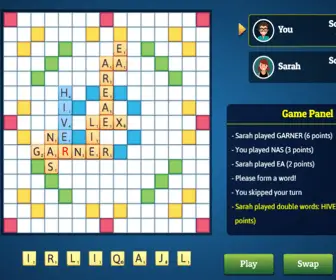
Wordmeister: The Scrabble Alternative I'd Recommend Trying
What I like about a good Scrabble-style game is that you can never be completely sure how a match will unfold. You might start with a terrible rack, spend two turns playing short words and then suddenly find a combination that changes the score completely.
Wordmeister captures that feeling particularly well. It doesn't try to reinvent the basic idea of Scrabble. You still have letter tiles, a board, bonus squares and an opponent trying to beat you. The difference is that everything is presented in a straightforward browser game, so you can concentrate on your next move rather than learning a complicated new system.
And having the computer as your opponent makes a real difference. You can take your time thinking about a word, but you also know that every square you leave open might become useful to the other side. That's what turns an ordinary word-building exercise into a proper contest.
I'd recommend Wordmeister especially to players who enjoy traditional Scrabble but want something they can start on their own, without arranging a match with another person.
My Favorite Part Is Thinking One Move Ahead
Imagine you have the letters to make a decent six-letter word. You find a place for it, check the points and realize it's a pretty good move. The obvious thing would be to play it immediately.
But then you notice something: placing that word would leave a triple-word square within easy reach of the computer. Your opponent might be able to use it on the very next turn.
That's the sort of decision that makes Wordmeister more interesting than simply trying to spell the longest word possible. Sometimes the move that scores fewer points right now is the better choice because it keeps your opponent away from a valuable part of the board.
It's a lesson that's easy to forget when you see a tempting score. I think that's also why games like Wordmeister remain enjoyable after you've learned the rules. You start paying attention to things you barely noticed during your first few matches.
Getting Started: Your First Wordmeister Match
If you've played Scrabble before, you should feel comfortable with the basics almost immediately. If you haven't, the game provides a tutorial, and the rules become clearer once you've placed your first few words.
- Start the Game – Enter the game and follow the opening instructions. Wordmeister determines who plays first by comparing randomly assigned letters.
- Check Your Letter Rack – Look for familiar combinations of vowels and consonants. Don't worry if your first set of letters doesn't contain an impressive word.
- Place Your First Word – Drag letters onto the board to create a valid English word. The opening word must pass through the center square.
- Confirm Your Move – Make sure the word is spelled correctly and submit it using the game's Play control.
- Watch the Computer Respond – Your opponent will place its own word, using the existing board to create another scoring opportunity.
- Build on Existing Words – On later turns, your new words must connect to letters already on the board.
- Keep Playing for the Higher Score – Continue until the remaining tiles and available moves bring the match to an end.
One detail worth remembering is that you can't place a new word in an isolated corner of the board. Every word after the first needs to connect to the existing arrangement, just as it would in a traditional crossword-style board game.
What If Your Letters Are Terrible?
We've all had that kind of Scrabble rack. You look down and see far too many consonants, or a collection of vowels that doesn't seem to make anything useful.
Wordmeister gives you a few ways to deal with it. You can shuffle the letters on your rack to look at them in a different order, exchange unwanted tiles or skip a turn.
I would try shuffling first. It doesn't magically create better letters, but sometimes rearranging them is enough to make a familiar word stand out. You might have overlooked a simple combination because the letters were sitting in an awkward order.
If that doesn't help, exchanging tiles is a reasonable option. Just remember that swapping uses your turn, so it's worth checking the board for a short playable word before giving up your chance to score.
Understanding the Colored Bonus Squares
One of the first things that catches your eye in Wordmeister is the collection of colored squares scattered around the board. They aren't just decoration. Used properly, they can turn an ordinary word into a surprisingly valuable move.
The colors indicate different scoring bonuses:
- Blue Squares – Double the point value of the letter placed on them.
- Green Squares – Triple the point value of the letter placed on them.
- Orange Squares – Double the total score of the word.
- Red Squares – Triple the total score of the word.
Here's where things get interesting. A short word placed on a valuable bonus square can sometimes score more than a longer word played across ordinary spaces.
Suppose you're holding a high-value letter like J or Z. Putting it on a triple-letter square can make a significant difference to your score. But if that placement also lets you complete a word on a word multiplier, the result can be even better.
The catch is that bonus squares are used when a tile is first placed on them. You can't keep collecting the same multiplier every time you extend a word through an occupied square.
Don't Hand the Best Squares to the Computer
It's tempting to concentrate entirely on your own score, especially when you've just discovered a good word. But the computer gets a turn after yours, and it can take advantage of the spaces you leave available.
Before confirming a move, I would always glance at the nearby bonus squares. If your word makes it easy for the opponent to reach a triple-word space, ask yourself whether there's another placement that offers a safer result.
You don't need to play defensively all the time. Sometimes opening the board is worth the risk, especially if you're behind and need a chance to catch up. The important thing is to recognize that you're making that choice.
Why I Prefer a Balanced Rack to a Perfect Word
One habit that can make a big difference in Wordmeister is paying attention to the letters you're leaving behind.
Imagine you have a chance to play a decent word, but doing so leaves you with several awkward consonants. You might score well on that turn, only to find yourself struggling to make anything useful afterward.
Now imagine a slightly smaller word that leaves you with a comfortable mixture of vowels and consonants. It may not look as impressive on the scoreboard immediately, but it gives you more possibilities when your next turn arrives.
That's why I wouldn't recommend chasing the longest possible word every single time. The strongest move often depends on what it leaves you with, not just what it earns right now.
Seven Things Worth Remembering While Playing Wordmeister
After you understand the basic rules, the challenge becomes less about learning the controls and more about making sensible decisions. These are the habits I'd focus on:
- Check the Bonus Squares First – Before settling on a word, see whether a slightly different placement could take advantage of a letter or word multiplier.
- Learn Useful Two-Letter Words – Short words can help you connect tiles in tight spaces and reach parts of the board that longer words can't access.
- Keep a Good Mix of Letters – Try not to leave yourself with too many vowels or too many consonants after every move.
- Think About the Computer's Next Turn – A high-scoring move isn't always worthwhile if it gives your opponent an even better opportunity.
- Don't Save Difficult Letters Forever – Holding onto a valuable tile for the perfect bonus square can backfire if that opportunity never appears.
- Use the Shuffle Option – Rearranging your rack can help you recognize combinations you missed the first time.
- Pay Attention Near the End – When the supply of tiles is running low, getting rid of awkward letters becomes increasingly important.
None of these ideas guarantees a win. That's actually part of the appeal. The letters you receive and the computer's decisions can create very different situations from one match to the next.
The Computer Opponent Makes Every Match Interesting
There's something convenient about playing against a computer. You don't need to find another player, arrange a time or wait for someone to join a room. You can simply open Wordmeister and start a match.
But convenience isn't the only advantage. The computer gives you a reason to pay attention to the whole board. It can extend your words, take advantage of bonus squares and force you to rethink the direction of your next move.
For example, you might spend a turn building a word toward the right side of the board, only for the computer to use the new letters to create a better scoring opportunity in another direction. Suddenly the area you were planning to use isn't as attractive anymore.
Those little changes keep the game from feeling repetitive. You're not solving the same puzzle over and over. You're responding to an opponent that changes the board after every turn.
Wordmeister vs. Scrabble Online and Outspell
If you enjoy traditional word board games, you'll probably notice that Wordmeister shares a lot with Scrabble Online and Outspell.
All three involve creating words from letter tiles and trying to score more points than your opponent. The difference is in how the games present that challenge.
- Wordmeister – A straightforward Scrabble-style game against the computer, with colored bonus squares and simple controls.
- Scrabble Online – A more traditional Scrabble experience for players who enjoy the familiar board game.
- Outspell – A Scrabble-inspired alternative with adjustable difficulty and bonus squares that can remain valuable when reused.
- Just Words – Another letter-placement game where forming words and making good use of the board are central to winning.
I wouldn't say Wordmeister needs to replace any of these games. It's simply another good option when you feel like playing a familiar word game with a slightly different presentation.
If you've spent a lot of time with Scrabble Online, switching to Wordmeister can be refreshing. The underlying strategy feels familiar, but the interface and flow of the match give it a different personality.
What I Like About Wordmeister, and What Could Be Better
The biggest reason I'd recommend Wordmeister is its simplicity. It doesn't overwhelm you with complicated features. You have a clear objective, familiar rules and an opponent ready to play.
I also like that the game rewards more than a large vocabulary. Knowing plenty of words helps, of course, but board positioning matters just as much. You can find a great word and still make a poor move if you place it carelessly.
There are a couple of things worth keeping in mind, though. If you're looking for a live multiplayer experience against another person, this isn't the game for that. Wordmeister is built around playing against the computer.
And if you prefer fast-paced word puzzles where letters disappear and new ones fall into place, you may enjoy Word Wipe or Scrabble Blast more. Wordmeister is a turn-based board game, so it naturally rewards patience and planning rather than quick reactions.
For me, that's a strength rather than a weakness. Sometimes it's nice to play a game where you can study the board, consider a few possibilities and make a decision without racing against a countdown.
What Happens Near the End of a Wordmeister Match?
The final turns can feel very different from the beginning of the game. Early on, you have plenty of space and lots of possible words. Later, the board becomes crowded, the available letters are running low and finding a useful place for your remaining tiles can be surprisingly difficult.
This is when those awkward letters you've been holding become a problem. A high-value tile might look promising, but it isn't much use if you can't find anywhere to play it.
Wordmeister ends when the available tiles have been exhausted and play can no longer continue, or when neither side can make another valid move. The player with the higher final score wins.
As the end approaches, I'd focus less on waiting for a spectacular word and more on making sure I can actually use the letters I have. A few modest moves can be better than finishing with an awkward rack and no place to play.
More Word Games You Might Enjoy
If you enjoy the strategic side of Wordmeister, try Just Words or Scrabble Demo for more opportunities to play against the computer.
For something less traditional, Text Twist 2 challenges you to discover words from a smaller collection of scrambled letters. Scrabble Sprint takes a different approach by asking you to find connected words inside a grid.
They're all word games, but the decisions you make in each one are quite different. That's what makes exploring a few alternatives worthwhile.
Should You Give Wordmeister a Try?
If you like Scrabble, my recommendation is simple: give Wordmeister a chance. You already know most of what you need to know, and the computer opponent makes it easy to enjoy a match whenever you have some free time.
Don't worry about winning your first game. Start by learning how the board works, experimenting with the bonus squares and getting comfortable with the letter controls. After a few turns, you'll probably find yourself thinking less about how to play and more about how to outsmart the computer.
And when you finally manage to turn an awkward rack into a high-scoring word, you'll understand why these games remain so enjoyable.
Play Wordmeister online for free, challenge the computer and see whether your next move is clever enough to give you the lead.
Frequently Asked Questions About Wordmeister
Is Wordmeister free to play?
Yes. Wordmeister is a free browser-based word game that does not require a download.
Is Wordmeister the same as Scrabble?
Wordmeister follows familiar Scrabble-style rules, including placing letter tiles, connecting words and using bonus squares, but it is a separate game with its own interface.
Can I play Wordmeister against the computer?
Yes. Wordmeister is a single-player game where you compete against a computer opponent.
What do the colored squares mean in Wordmeister?
Blue squares double a letter's score, green squares triple a letter's score, orange squares double a word's score and red squares triple a word's score.
Can I swap letters in Wordmeister?
Yes. You can exchange unwanted letter tiles, although swapping uses your turn.